










ZF Hits the Brakes on Electrification
ZF closed 2025 with lower group sales but improved operating profitability, stronger free cash flow and reduced net debt, while posting a net loss driven by one-off charges linked mainly to the early termination of non-profitable electric mobility projects.
- | Kamyonum
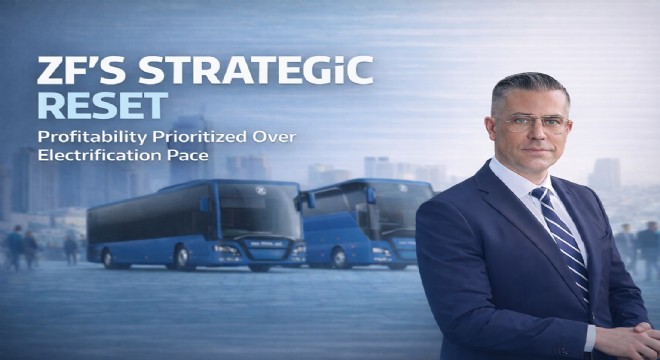
ZF Reports Lower Sales but Improved Profitability in 2025; Electrified Powertrain Restructuring and ADAS Divestment Mark Strategic Shift
Sales decline, margins improve
The German supplier reported group sales of €38.8 billion in 2025, down from €41.4 billion in 2024, while stating that organic growth reached 0.6 percent.
Despite the decline in revenue, ZF improved its operational performance:
- Adjusted EBIT margin: 4.5% (up year-on-year)
- Free cash flow: significantly higher
- Net debt: reduced to €10.2 billion
The company emphasized that profitability and efficiency are now taking precedence over volume growth.
Electrification strategy reset
ZF reported a net loss of €2.1 billion, mainly due to a one-off charge of approximately €1.6 billion.
This was largely linked to:
- The restructuring of its Electrified Powertrain Technology Division
- The early termination of several customer projects
According to ZF, these projects would not have reached the required profitability due to the slower-than-expected ramp-up of electric mobility.
This signals a broader shift in strategy:
A more selective approach to electrification
Increased focus on financially viable programs
ADAS divestment and strategic focus
A key element of ZF’s repositioning is the planned sale of its Advanced Driver Assistance Systems (ADAS) business to Harman, at an enterprise value of €1.5 billion.
The transaction is expected to close in the second half of 2026, subject to regulatory approvals.
This move reflects a clear intention to:
- Streamline the portfolio
- Focus on core competencies
- Improve capital allocation
Weak commercial vehicle outlook
ZF expects global economic conditions to remain uncertain in 2026, with persistently weak demand in the commercial vehicle sector.
The company forecasts:
- Group sales of more than €38 billion
- Adjusted EBIT margin between 4.0% and 5.0%
- Adjusted free cash flow above €1 billion
Regional performance
ZF’s revenue distribution remained stable in Europe but declined in other key regions:
- EMEA: €19.3 billion (stable)
- Germany: €8.5 billion (increase)
- North America: €10.0 billion (decline)
- Asia-Pacific & India: €8.2 billion (decline)
- China: €5.7 billion (down from €6.4 billion)
Workforce reduction and cost measures
The company reduced its global workforce to 153,153 employees, down from 161,631 in 2024.
In Germany, headcount fell to 49,210, and ZF confirmed it is on track to reduce its German workforce by 11,000 to 14,000 positions.
Measures include:
- Natural attrition
- Severance programs
- Reduced working hours
Bus segment shows strong growth
Despite broader market challenges, ZF highlighted strong momentum in its bus business.
The company reported that:
- The bus segment has grown by 30% over the last three years
- The order pipeline exceeds €1 billion
Call for regulatory adjustments
ZF CEO Mathias Miedreich also addressed regulatory pressures, particularly in Europe.
He emphasized the need for:
- Greater flexibility in CO? legislation
- Recognition of plug-in hybrids as a transition technology
According to ZF, plug-in hybrids can:
- Reduce range anxiety
- Support the ramp-up of electric mobility
- Help safeguard industrial jobs
Conclusion
ZF’s 2025 results highlight a turning point for the automotive supplier industry.
While electrification remains a long-term priority, the company is clearly shifting toward:
Profitability over volume
Selective investment over broad expansion
Financial discipline over aggressive growth
The message is clear:
The transition to electric mobility is entering a more pragmatic and economically driven phase.
YORUMLAR
Yorum Yap