










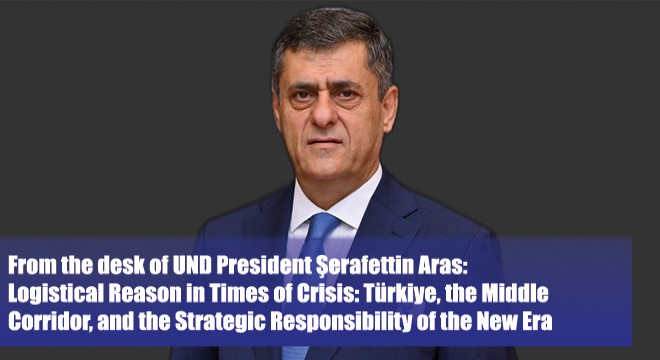
From the desk of UND President Şerafettin Aras
Logistical Reason in Times of Crisis: Türkiye, the Middle Corridor, and the Strategic Responsibility of the New Era
- | Kamyonum
Today, the world is witnessing not only a security crisis, but also a search for a new order in trade, supply, and logistics. The conflict escalating along the U.S.-Israel-Iran axis since February 28, 2026, has seriously shaken trade and energy flows around the Strait of Hormuz; risk, cost, and uncertainty in maritime transport have grown rapidly. Under normal conditions, approximately one-fifth of the world’s oil supply passes through Hormuz, and today, disruptions on this route directly affect not only energy markets, but also freight rates, insurance costs, delivery times, and global supply planning.
In such periods, countries have two options: either they bear the burden of the crisis, or they transform the crisis into a strategic advantage through collective wisdom, rapid reform, and regional cooperation. This is precisely the main issue facing Türkiye today. Because the developments we are experiencing now are of a nature that can strengthen Türkiye’s claim to be not merely a transit country, but a reliable, fast, and flexible logistics hub between Europe and Asia. The path to this lies not only in geography, but in bold decisions, simplified processes, and regional coordination.
As risk increases in maritime transport, cargo naturally shifts toward safer and more predictable alternatives. It is exactly here that the Türkiye–Middle Corridor route, especially the route shaped through Azerbaijan and Georgia, can become one of the main arteries of the new era. Existing studies already show that the Middle Corridor can offer a shorter and faster alternative compared to the Suez or northern routes. According to Azerbaijan’s official data, this route can reduce transit times to as little as 13–21 days for some shipments; in Türkiye’s official foreign policy narrative, the Middle Corridor is also emphasized as an axis that is approximately 2,000 kilometers shorter than the northern route and provides a time advantage in Europe-Asia transportation. The World Bank also points to the potential for a significant increase in cargo volume and important improvements in transit times if this corridor is managed properly.
However, it must be said honestly that the opportunity itself is not enough on its own. If there is no system capable of carrying the opportunity, cargo flows will shift to other countries and other corridors. Therefore, the issue is no longer the question, “Is Türkiye advantaged?” The real question is this: will the transit countries of this corridor, such as Türkiye, Bulgaria, Azerbaijan, and Georgia, be able to take the decisions necessary to manage this advantage quickly enough?
At this point, the first thing that must be done is to turn the Bulgaria–Türkiye–Azerbaijan–Georgia line into a genuine speed corridor. To achieve this, border crossings between the countries must be redesigned not only physically, but also administratively and digitally. World Bank and OECD studies clearly show that one of the biggest obstacles to corridor performance is waiting times at border gates, fragmented procedures, and incompatible data flows. OECD’s latest assessments also reveal that digital logistics, customs automation, and real-time data integration in the Trans-Caspian/Middle Corridor are no longer a choice, but a necessity.
Here, the concrete objective is clear: joint border gates, joint control points, advance data sharing, a single window system, one-stop processing, risk-based inspection, and a fast-track model for trusted carriers. The World Trade Organization’s Trade Facilitation Agreemen defines the single window system as the fundamental tool for conducting import, export, and transit procedures through a single entry point. UNECE and WCO documents clearly demonstrate that coordinated border management and the joint border gate model reduce repetitive controls and speed up crossings. In UNCTAD’s ASYCUDA examples as well, it can be seen that digitalization and inter-agency coordination are capable of dramatically reducing customs clearance times.
The Tabanovce–Preševo Border Gate is an important crossing point that serves as an example of joint and coordinated control implementation between North Macedonia and Serbia. At this point, the controls of the two countries are combined into a single stop, thereby shortening transit times. In addition, the Albi?a (Romania) – Leu?eni (Moldova) line also stands out as one of the successful examples in which, even if the “one-stop shop” model is not fully implemented between an EU country and a non-EU country, the customs administrations of the two countries work in constant coordination on the ground and ensure effective information flow. Evaluations by the World Bank and relevant institutions show that the logic of the joint border gate reduces repetitive procedures, lowers transit times, and increases corridor efficiency. The essence of this model is very clear: the two countries do not carry out procedures separately and consecutively; they operate on the same site with a shared workflow. This should be exactly the logic of the advanced logistics coordination that Türkiye will establish with Georgia and Azerbaijan.
Today, it must now be said clearly:
As risk increases in maritime transport, a shift toward road transport is inevitable.
But in order to attract the cargo shifting toward road transport, roads alone are not enough; decisions are needed, coordination is needed, courage is needed.
The European Commission’s “Green Lanes” approach implemented during the pandemic kept supply chains functioning by adopting the principle that controls at border crossings for freight vehicles should not exceed 15 minutes. Likewise, the “Solidarity Lanes” model created for Ukraine demonstrated how alternative logistics corridors can be activated under wartime conditions. These examples tell us the following: in times of crisis, systems that facilitate cargo, not systems that restrict it, are the ones that create value.
The second critical issue is to establish a European access regime that can genuinely carry the cargo shifting to road transport. Today, when risks in maritime transport increase, it is theoretically possible for cargo to return to land routes; however, in practice, driver visas, transit permits, quota restrictions, and bottlenecks at certain border crossings limit this transition. Therefore, in order for Türkiye to seize the logistics opportunity, it must open not only the eastern route, but also the western gates.
The driver visa issue in particular is now no longer merely a problem of human mobility; it is directly a problem of supply chain security. Even in the more positive Schengen arrangement introduced by the European Commission in 2025 for Turkish citizens, the exclusion of truck drivers from the scope demonstrates how critical the problem is. In the same period, the shortage of heavy vehicle drivers in Europe became structural; the EU and relevant institutions brought the search for solutions concerning third-country drivers more visibly onto the agenda. At the beginning of 2026, protests regarding Schengen stay rules for Western
Balkan drivers and the approach before the Commission that “a professional driver is not a tourist” also confirm this reality.
For this reason, Türkiye’s demand must be clear and legitimate:
A special, fast, multiple-entry, long-term logistics visa regime must be established for professional drivers carrying international freight. A driver is not a person traveling for tourism; he is a working component of Europe’s supply chain. At a time when the European economy is experiencing a driver shortage, the fact that the very driver carrying the goods gets caught in visa and entry-exit barriers is incompatible with economic rationality. On this matter, Türkiye must conduct systematic and data-based diplomacy with EU institutions and the relevant transport authorities of the countries concerned.
The third issue is the abolition of transit permits and quotas, or at the very least their suspension during times of crisis. In times of crisis, quota regimes that limit capacity in fact punish not only the carrier, but also the industrialist, the exporter, and the consumer. The Green Lanes approach implemented by the European Union during the COVID period is extremely instructive in this respect. The Commission declared that the total waiting time of freight vehicles at border crossings should not exceed 15 minutes, and even in a period when borders were closing, it regarded maintaining cargo flows as a primary priority. Likewise, the Solidarity Lanes developed after the Russia-Ukraine war created alternative logistical arteries in place of routes closed by war and have enabled the movement of over 200 million tons of goods since 2022. This means that, in times of crisis, the correct reflex is not restriction, but the establishment of temporary yet effective regimes that facilitate transport.
Türkiye must advocate the same approach. Europe should be given this clear message: if risk in maritime transport is increasing and cargo is going to shift toward safer overland corridors, then the artificial obstacles before road transport must be reduced. As long as quotas, long waiting times, fragmented document checks, appointment uncertainty, and visa bottlenecks continue, discourse about an “alternative corridor” cannot be credible.
The fourth issue is the simplification and digitalization of customs procedures. No country can any longer establish a competitive corridor merely by building asphalt and gates. Competition is measured by how quickly data flows, how many times documents are requested, how well the ratio of physical inspection is optimized through risk analysis, and how predictable a waiting time the carrier encounters at the border. For this reason, it is essential that Türkiye and the countries of the region accelerate joint data sharing, acceptance of e-documents, e-permits, e-CMR, pre-declarations, mutual data recognition, and common digital platforms for transit flows. Azerbaijan’s e-permit application for 15,000 permits with Türkiye launched in 2025 is a concrete step taken in the right direction; such practices must be expanded and made permanent.
Here, inter-agency cooperation is as decisive as interstate cooperation. Between Türkiye, Bulgaria, Azerbaijan, and Georgia, not merely declarations of goodwill, but a Corridor Executive Mechanism with measurable targets must be established. For example, the four countries could commit to maximum transit times at certain gates; they could establish a joint data panel; publish weekly bottleneck reports; and create a joint desk that would resolve operational complaints from carriers within 24 hours. As also emphasized in the corridor performance studies of the OECD and the World Bank, modern corridors grow not only through infrastructure, but through governance capacity.
Although the growth of risk in maritime transport may at first glance appear to be a negative development, if managed correctly from Türkiye’s perspective, this period can become a historic opportunity to expand the Middle Corridor, reposition transport between Europe and Asia, and finally resolve structural problems that have remained unsolved for years. Because crises make reforms compulsory that are postponed in normal times. Europe did this during the COVID period; new logistics lines were established for Ukraine during wartime; joint border gate models accelerated trade in Africa. Now Türkiye and the countries of the region must be able to show a similar resolve.
Our approach is this;
What is needed today is not to complain about the crisis, but to institutionalize, together with neighboring countries, the logistical wisdom that will manage the crisis.
If we can do this, the risks emerging today in the shadow of the fire in the Middle East may become the beginning of tomorrow’s Türkiye-centered logistics order.
Because the issue is no longer simply to carry cargo.
The issue is to determine the new direction of trade.
Şerafettin Aras
President of the International Transporters’ Association (UND)
YORUMLAR
Yorum Yap