










Knorr-Bremse to Launch Redundant Braking System for Level 4 Autonomous Trucks in 2027
The new rGSBC system is designed to maintain braking performance even in the event of a primary system failure, supporting the safe commercial deployment of driverless heavy-duty trucks.
- | Kamyonum
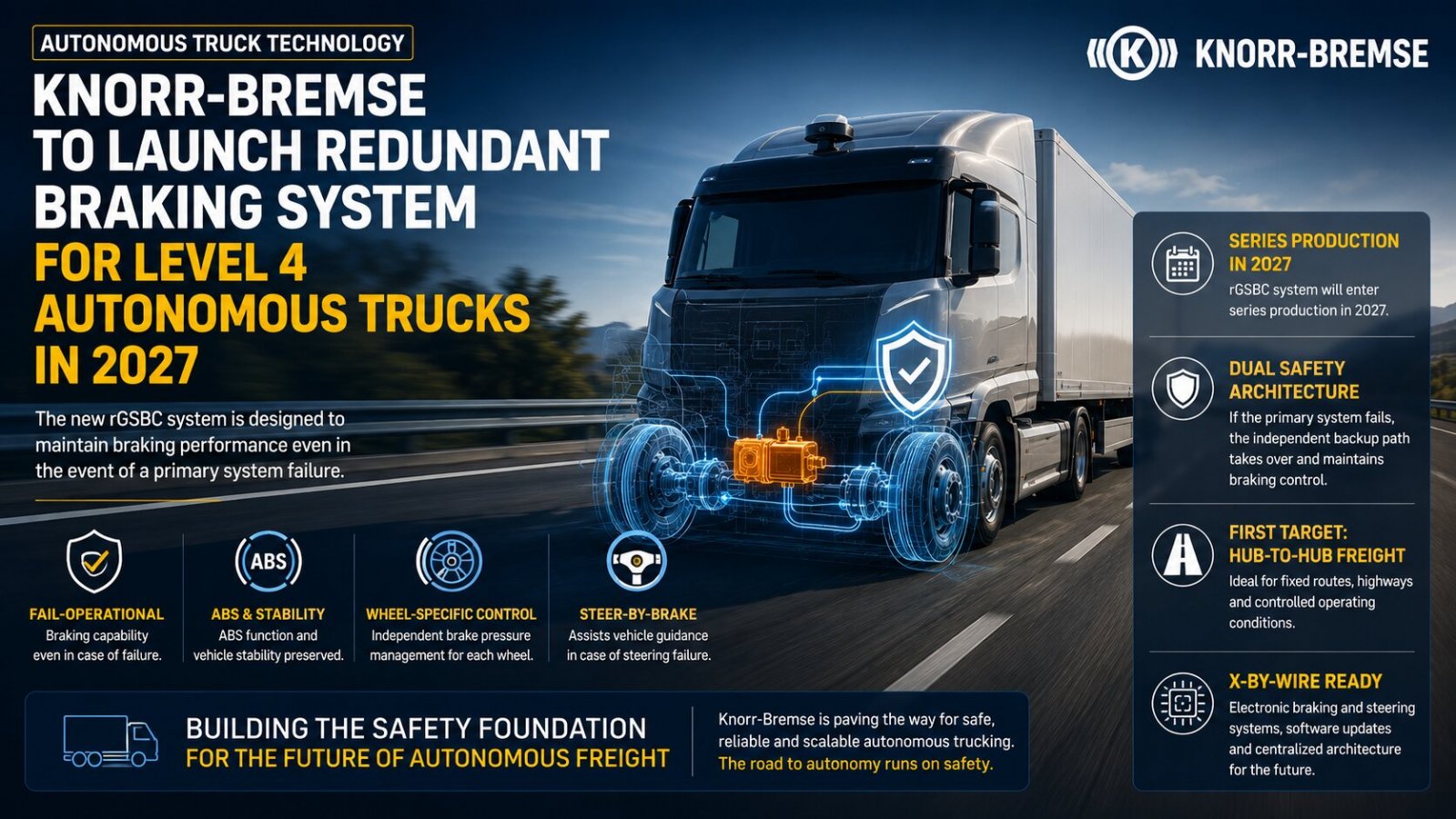
Knorr-Bremse to Launch Redundant Braking System for Level 4 Autonomous Trucks in 2027
As the commercial trucking industry moves closer to large-scale autonomous freight operations, functional safety has become just as critical as perception software and artificial intelligence.
German braking systems specialist Knorr-Bremse has announced that it plans to begin series production of its redundant Global Scalable Brake Control (rGSBC) system in 2027, providing an additional layer of braking safety for SAE Level 4 autonomous commercial vehicles.
Unlike conventional braking architectures, the rGSBC system introduces a fully independent secondary control path. If the primary braking controller becomes unavailable, the backup system can continue managing wheel-specific brake pressure, preserve ABS functionality, and maintain vehicle stability, enabling the truck to execute a controlled stop or continue operating under predefined safe conditions.
Redundancy Is Essential for Driverless Operation
In conventional trucks, a human driver can respond to system failures. Level 4 autonomous trucks, however, are designed to operate within their Operational Design Domain (ODD) without requiring driver intervention.
For this reason, automated vehicles must be capable of maintaining critical functions even when individual components fail.
Knorr-Bremse's redundant braking architecture is intended to eliminate single points of failure in the braking system, an important requirement for the commercial deployment of autonomous heavy-duty vehicles.
Beyond Emergency Braking
The rGSBC platform supports multiple fail-operational strategies.
One allows the vehicle to perform a Minimum Risk Maneuver (MRM), bringing the truck to a controlled stop in a safe location.
Another enables a Mission Complete strategy, allowing the vehicle to continue operating safely until the current transport task can be completed, depending on the nature of the fault and operational conditions.
The standardized electronic interfaces also allow seamless integration with autonomous driving software while remaining compatible with conventional vehicle architectures.
Steering Redundancy Complements the Safety Concept
Knorr-Bremse is also developing a redundant Electric Power Steering (rEPS) system for autonomous trucks.
In addition, its Steer-by-Brake technology can assist vehicle guidance by selectively applying brake pressure to individual wheels if steering functionality is compromised.
Together, these technologies create a layered safety architecture aimed at supporting future software-defined commercial vehicles.
First Commercial Applications
According to Knorr-Bremse, one of the first commercial applications for the technology is expected to be hub-to-hub autonomous freight transport, where vehicles operate on predefined highway corridors under controlled operating conditions.
Core components of the braking and steering technologies have already been validated through Germany's ATLAS-L4 autonomous truck research project, one of Europe's most significant initiatives in autonomous commercial vehicle development.
Towards Software-Defined Trucks
The new braking platform also reflects the industry's broader transition toward X-by-Wire vehicle architectures, where mechanical connections are increasingly replaced by electronically controlled systems.
As software-defined trucks become more common, redundant braking, redundant steering, centralized electronic control units, and fail-operational system architectures are expected to become fundamental building blocks for safe autonomous transport.
Kamyonum Analysis
While much of the industry's attention has focused on sensors, AI algorithms and autonomous driving software, functional safety remains one of the most important challenges before driverless trucks can achieve large-scale commercial deployment.
Knorr-Bremse's planned 2027 production launch does not mean autonomous trucks will immediately become widespread. However, it represents an important milestone in the development of production-ready safety architectures required for Level 4 commercial operations.
YORUMLAR
Yorum Yap