










Daimler Truck and Torc Gear Up for 2027: Where Does the Level 4 Autonomous Cascadia Stand?
Daimler Truck and Torc Robotics are advancing the productization of an SAE Level 4 autonomous Freightliner Cascadia, targeting US market entry by 2027. Driver-out validation has been completed on a closed test track, the fifth-generation Cascadia has joined Torc’s fleet with production-intent hardware, and the long-range 4D LiDAR program has reached the C-sample stage. However, driver-out commercial operations on public roads have not yet been announced.
- | Kamyonum
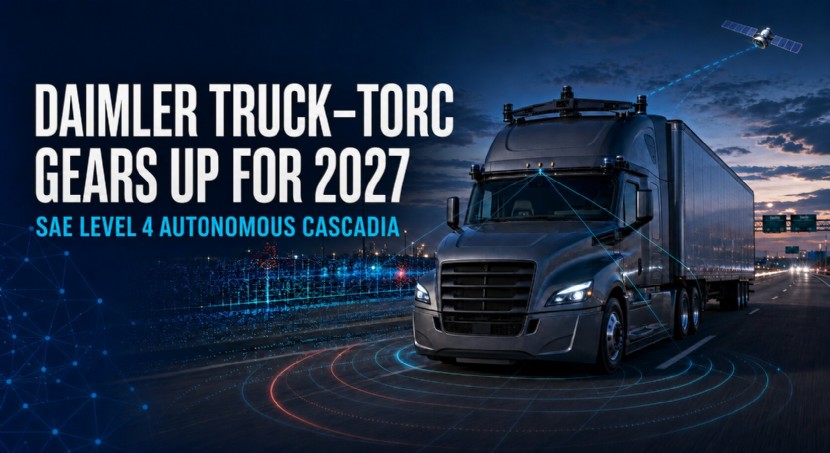
Competition in autonomous trucking is moving beyond technology demonstrations and toward productization, industrialization and commercial operations. Daimler Truck and its independent subsidiary Torc Robotics are among the companies leading this transition, with a stated goal of bringing an SAE Level 4 autonomous Freightliner Cascadia to the US market by 2027.
The progress is significant, but the current status must be described accurately. Torc has completed driver-out validation without a safety driver on a closed test track. Public-road testing is continuing, but the companies have not announced the start of driver-out commercial freight operations on public roads.
Level 4 does not mean driverless operation everywhere
Under SAE Level 4 automation, the automated driving system can perform the entire dynamic driving task within a defined operational design domain, or ODD, without expecting a human driver to intervene.
This does not mean the truck can operate autonomously on every road or under every weather and traffic condition.
The Daimler Truck–Torc program is initially focused on US long-haul freight and hub-to-hub operations between designated logistics facilities. Its operational design domain is defined by approved routes, road characteristics, weather conditions, operating rules and technical limitations.
Driver-out validation completed on a closed test track
In October 2024, Torc Robotics reached a major milestone during driver-out validation on a closed multi-lane test track in Texas. The truck operated without a safety driver at speeds of up to 65 mph, approximately 105 km/h.
Click here for the official announcement on Torc’s closed-course driver-out validation
The milestone demonstrated that the system could perform the driving task without human intervention in a controlled environment. However, closed-course validation and driver-out commercial operation on public roads are separate stages of development.
Torc says its public-road testing has covered highways, surface streets, ramps and controlled intersections. Based on the official announcements reviewed, commercial freight operations without safety personnel on public roads have not yet been announced.
Fifth-generation Cascadia joins the test fleet
In 2025, Daimler Truck North America delivered its latest autonomous-ready platform, based on the fifth-generation Freightliner Cascadia, to Torc’s testing fleet. The vehicle incorporates production-intent autonomy hardware.
The platform includes redundant steering, braking, communications and power-network systems. These are intended to help the truck remain controllable if a safety-critical component fails. Daimler Truck North America says more than 1,500 engineering requirements were addressed during the vehicle’s development.
Daimler Truck North America plans to integrate the essential sensor and computing components during the vehicle manufacturing process. Torc will integrate the TorcDrive virtual driver, perception systems and operational infrastructure.
This indicates that the program has progressed beyond demonstration prototypes and entered a productization and validation phase using production-intent hardware. It does not mean that testing, validation and safety development have been completed.
Click here for the official announcement on the fifth-generation autonomous-ready Cascadia
Testing expands to Michigan public roads
Torc’s public-road program includes routes in New Mexico, Texas and Arizona, together with the I-35 corridor between Laredo and Dallas. In February 2026, the company expanded autonomous-truck testing to public roads in Michigan.
The work in the Greater Ann Arbor area is intended to expose the system to different seasons, road conditions, weather and traffic environments while generating additional real-world data.
Torc’s announcement does not state that its Michigan tests are being conducted without a safety driver. The development should therefore be described as an expansion of the public-road testing and validation program, rather than the start of driver-out commercial operations.
Click here for Torc Robotics’ official announcement on public-road testing in Michigan
TorcDrive and the AV 3.0 architecture
TorcDrive serves as the virtual driver at the centre of the autonomous-truck system. Torc describes AV 3.0, introduced in 2025 and detailed further in 2026, as an AI-driven architecture built around perception, prediction and planning.
The perception component uses data from cameras, radar and LiDAR sensors to identify the road environment and surrounding objects. Prediction evaluates the likely behaviour of other road users, while planning determines the truck’s intended course of action.
Torc describes its architecture as a “glass box” approach in which learned AI models operate alongside deterministic safety criteria and guardrails. This description and the associated performance claims come from the company.
Simulation supports development and validation, but it does not replace closed-course and public-road testing under real operating conditions.
Click here for Torc Robotics’ explanation of TorcDrive and the AV 3.0 architecture
Long- and short-range LiDAR systems
The Daimler Truck–Torc sensor architecture combines cameras, radar and LiDAR systems designed for different detection ranges.
Aeva was selected to supply long-range LiDAR technology for the program. Its FMCW-based 4D LiDAR can measure both the distance and instantaneous velocity of detected points.
Aeva says its Atlas platform is designed to provide long-range detection at distances of up to 500 metres. This figure should be understood as a technical performance statement made by the supplier.
In May 2026, the first C-sample Atlas 4D LiDAR units were delivered to Daimler Truck North America and Torc. Reaching the C-sample stage indicates progress toward a production-representative design, but it does not mean that series production has been completed. Integration, system optimization and validation work remain underway.
Click here for the official announcement on the delivery of Aeva Atlas 4D LiDAR C-samples
InnovizTwo technology is planned for the short-range LiDAR layer. Combining long- and short-range sensors is intended to help the truck monitor both distant highway hazards and areas close to the vehicle.
Click here for the official announcement on the InnovizTwo short-range LiDAR partnership
Manufacturing and service models are being developed together
Under the model described by Daimler Truck, the sensors and core hardware required for an autonomous-ready truck are expected to be integrated during factory production.
The objective is to allow customers to purchase an autonomous-ready vehicle directly from the manufacturing plant instead of relying on an extensive post-production sensor retrofit.
Torc’s virtual-driver technology and supporting Mission Control services are expected to be offered to customers through a subscription model. Pricing and final commercial terms have not yet been disclosed publicly.
What does the program mean for Türkiye?
Daimler Truck and Torc Robotics have not announced an SAE Level 4 commercial deployment plan for Türkiye. The current program is focused on US long-haul and hub-to-hub freight operations.
Work conducted by the Autonomous Vehicles Working Group within the Turkish Standards Institution has addressed issues such as special permission for SAE Level 4 testing and temporary test registration plates. However, a comprehensive framework generally authorizing commercial Level 4 truck operations on Turkish public roads has not yet been introduced.
Review the Turkish Standards Institution’s autonomous-vehicle study — Turkish-language document
In the near term, Türkiye is therefore more likely to focus on testing permissions, liability, insurance, vehicle certification, digital infrastructure, high-definition mapping, data management and autonomous-ready logistics hubs than on immediate driver-out truck operations.
For Turkish logistics companies, the first practical effects may emerge through advanced driver-assistance systems, remote fleet monitoring, predictive maintenance, digital control centres and driver-supported automation.
These Türkiye-related points are editorial assessments based on currently announced technology programs and publicly available official studies. Daimler Truck and Torc have not published a commercial timetable for Türkiye.
Targeting 2027, with major work still ahead
Daimler Truck and Torc Robotics continue to target US market entry by 2027. Closed-course driver-out validation, the addition of the fifth-generation Cascadia with production-intent hardware and the delivery of C-sample long-range LiDAR units represent tangible progress toward that objective.
However, the companies have not announced the start of driver-out commercial freight operations on public roads.
The program’s ultimate success will depend on technical validation, safety performance, industrial readiness, regulatory approvals and whether logistics operators can deploy the system economically at scale.
YORUMLAR
Yorum Yap