










Aurora Launches Second-Generation Driverless Trucks
Aurora has launched its second-generation driverless trucks based on the International LT Series platform. The company reported nearly 440,000 driverless miles as of the end of June 2026, while manufacturing partner Roush is targeting an annual production run-rate of 1,000 Aurora trucks later this year.
- | Kamyonum
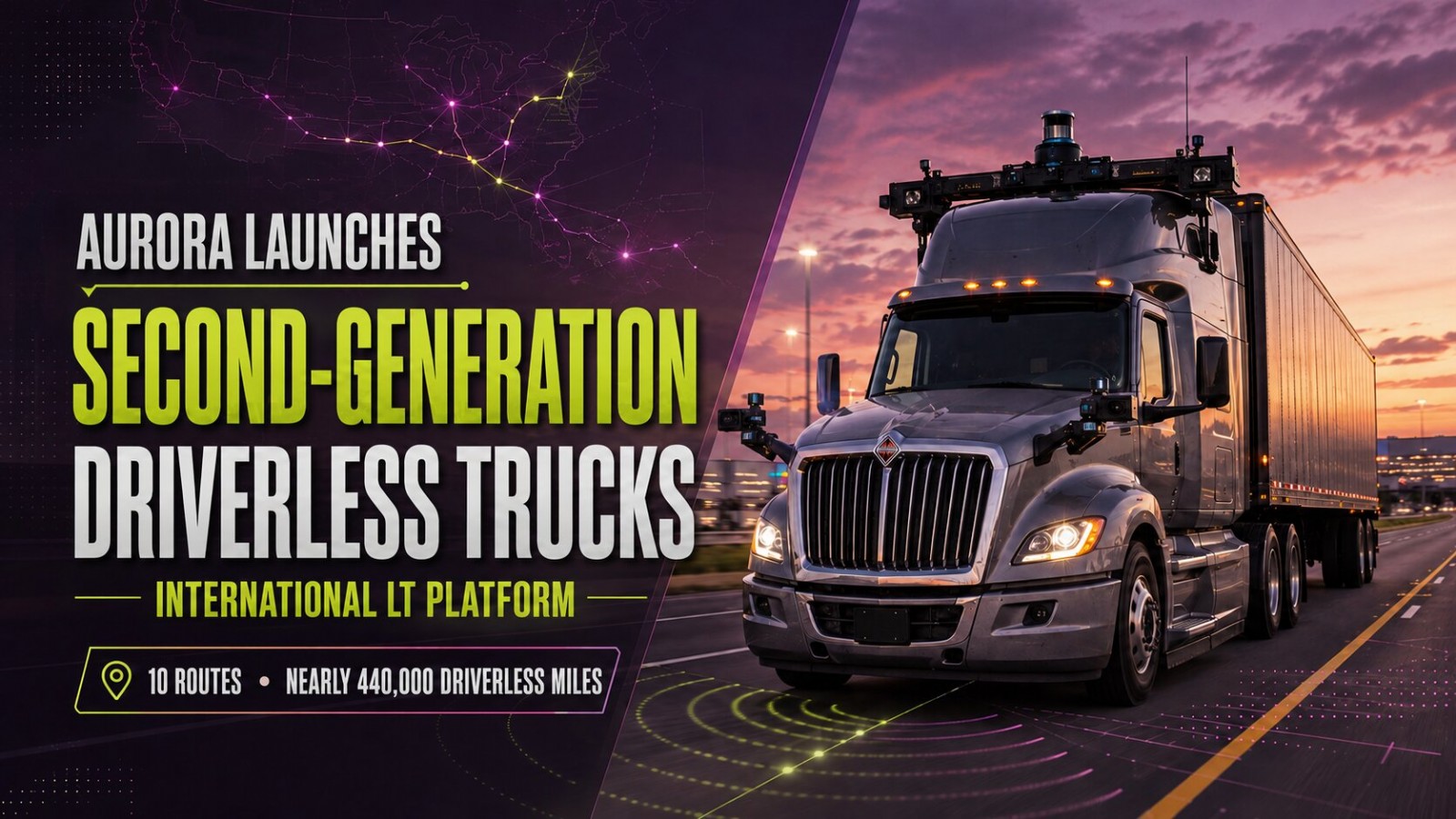
Autonomous freight transportation is moving beyond limited technology demonstrations and towards the commercial scaling of driverless operations. Aurora Innovation has announced the launch of its second-generation driverless heavy-duty trucks in the United States.
The new vehicles are based on the International LT Series platform and will be deployed across Aurora’s commercial network to serve additional freight customers. According to the company’s announcement dated 22 July 2026, the network currently encompasses 10 driverless routes across the U.S. Sun Belt.
Aurora states that the trucks operate without a person behind the wheel. However, this does not mean they can drive independently on every road or under all weather and traffic conditions. The Aurora Driver is an SAE Level 4 system designed to perform the complete driving task within a defined operational design domain.
New Platform Based on the International LT Series
Aurora’s second-generation fleet is based on the International LT Series heavy-duty truck platform and incorporates the company’s next-generation autonomous-driving hardware.
According to Aurora, the new hardware offers greater computing power and is designed to last one million miles, approximately 1.61 million kilometres. This figure represents the hardware’s stated design-life target; it does not mean that the new trucks have already travelled one million miles.
The Aurora Driver combines cameras, radar, LiDAR, high-performance computing and artificial intelligence-based driving software. These systems work together to detect the surrounding environment, predict the movements of other road users, plan manoeuvres and generate steering, acceleration and braking commands.
Redundant Systems for Driverless Operation
When a heavy-duty truck operates without a human driver, there is no one behind the wheel to take control if a critical system fails. The truck platform therefore requires redundant safety systems capable of maintaining control or bringing the vehicle to a safe condition.
Aurora’s manufacturing partner Roush is installing redundant vehicle systems and integrating the next-generation Aurora Driver hardware at a dedicated production facility.
Aurora’s previous technical disclosures identified braking, steering, power, sensing, vehicle control, computing, cooling and communications among the critical functions that require redundancy for driverless operation.
Safety Case Completed for the New Truck
Aurora says it completed its Safety Case for the second-generation truck and hardware before beginning public-road operations without a person behind the wheel.
The company’s Safety Case Framework brings together technical and operational evidence relating to normal driving, system failures, foreseeable misuse, cybersecurity, remote assistance and the system’s operational limitations.
Completing this Safety Case should not be interpreted as unrestricted approval for the truck to operate under every possible condition. It represents Aurora’s evidence-based assessment that the system is acceptably safe within its specified operational design domain.
Nearly 440,000 Driverless Miles Completed
Aurora launched its commercial driverless trucking service between Dallas and Houston in May 2025. As of the end of June 2026, the Aurora Driver had completed nearly 440,000 miles—approximately 708,000 kilometres—without a person behind the wheel.
This figure is separate from the millions of miles accumulated during supervised development and commercial pilot operations. The reported 440,000 miles relate specifically to operations that Aurora classifies as driverless.
Aurora’s launch customers included Uber Freight and Hirschbach Motor Lines. The company intends to use its second-generation trucks to increase capacity on existing routes and serve additional freight customers.
Roush Targets an Annual Run-Rate of 1,000 Trucks
Aurora and Roush have formalised an upfit process for installing redundant systems and integrating autonomous-driving hardware into the International LT-based trucks.
Roush is targeting an annual production run-rate of 1,000 Aurora trucks later in 2026. This does not mean that 1,000 trucks have already been produced or entered commercial service. It describes the annualised production pace that the facility is expected to be capable of reaching.
Aurora CEO and co-founder Chris Urmson said the company’s initial driverless launch demonstrated that the technology could operate on public roads, while the new platform provides the foundation required for larger-scale deployment.
500-Truck Plan Is Not Yet a Binding Order
Aurora’s growth strategy also includes an expanded partnership with Hirschbach Motor Lines. The companies have signed a memorandum of understanding outlining a pathway for Hirschbach to own 500 Aurora Driver-powered trucks.
Deliveries are planned to begin in 2027. However, Aurora explicitly states that the memorandum is non-binding and that final commercial terms and timing remain subject to definitive agreements.
The development should therefore not be described as a confirmed order for 500 trucks. At this stage, it represents a proposed fleet-expansion plan that depends on the completion of binding contracts.
What Does It Mean for Türkiye?
Aurora’s second-generation driverless truck programme is focused on the United States and defined freight corridors within the country. No commercial deployment schedule has been announced for Türkiye.
Nevertheless, the programme provides important indications for Türkiye’s heavy commercial vehicle and logistics sectors. Scaling autonomous trucking requires much more than driving software. It also depends on:
- Redundant steering and braking systems
- Advanced sensing and computing hardware
- Specialised maintenance procedures
- Remote operational support
- Cybersecurity infrastructure
- Digital fleet-management systems
- Validated freight corridors
- Continuous communication between vehicles and control centres
Türkiye’s first realistic Level 4 applications may emerge in controlled environments such as ports, logistics centres, organised industrial zones, mines and repetitive highway corridors rather than unrestricted operation across the entire public-road network.
Commercial Level 4 freight operations would also require a comprehensive regulatory framework covering vehicle approval, testing permits, liability, insurance, cybersecurity, data management and remote operational supervision.
The Next Challenge Is Manufacturing Scale
The launch of Aurora’s second-generation trucks indicates that the company’s focus is shifting from demonstrating driverless capability to increasing vehicle production and expanding commercial operations.
Nearly 440,000 driverless miles represent an achieved operational figure. By contrast, Roush’s annual production run-rate of 1,000 trucks and Hirschbach’s proposed 500-truck fleet remain forward-looking targets.
The programme’s long-term commercial success will depend on safety performance, vehicle uptime, maintenance requirements, cost per mile and whether proposed customer agreements are converted into binding orders.
Read this article in Turkish →
https://www.kamyonum.com.tr/haber/Aurora-Ikinci-Nesil-Surucusuz-Kamyonlarini-Devreye-Aldi/46798
Source Links
YORUMLAR
Yorum Yap