










HPDI Technology: Cespira's Approach to High-Performance LNG and bioLNG Powertrains
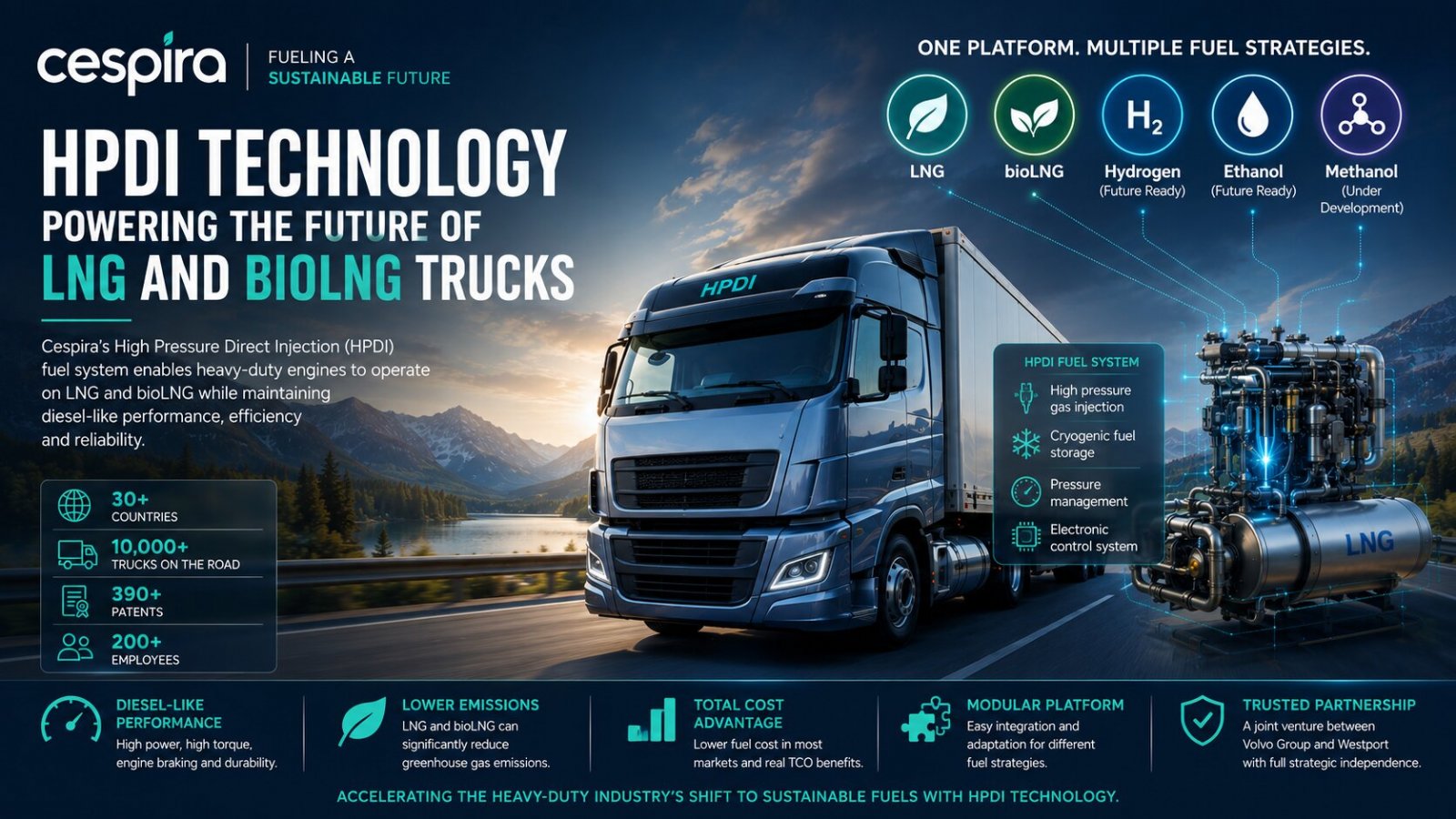
Cespira, the joint venture between Volvo Group and Westport, is developing its High Pressure Direct Injection (HPDI) fuel system to enable heavy-duty engines to operate on LNG and bioLNG while maintaining diesel-like performance, efficiency and operational capability.
- | Kamyonum
As the commercial vehicle industry accelerates its transition toward lower-carbon transport, manufacturers are increasingly investing not only in electrification but also in technologies that enable existing engine architectures to operate with alternative fuels.
One of the companies driving this transition is Cespira, a joint venture between Volvo Group and Westport, focused on developing advanced fuel system technologies for heavy-duty engines.
The company's flagship solution, High Pressure Direct Injection (HPDI), is designed to enable heavy-duty vehicles to operate on LNG and renewable bioLNG while preserving the performance characteristics expected from conventional diesel powertrains.
Unlike a new engine platform, HPDI is a fuel system technology that integrates high-pressure fuel injection, cryogenic fuel storage, pressure management and electronic controls into existing heavy-duty engine architectures.
According to Cespira, this approach allows manufacturers to reduce greenhouse gas emissions through LNG and renewable bioLNG without compromising the power, torque and long-haul capability required in commercial transport.
The company also emphasizes that its HPDI platform has been developed as a modular architecture capable of supporting future alternative fuel strategies as market requirements evolve.
Today, Cespira reports that its HPDI technology is operating in more than 30 countries, with over 10,000 trucks equipped with the system worldwide. The company also holds more than 390 patents, reflecting years of research and development in advanced fuel injection technologies.
As global regulations continue to tighten and transport operators seek practical pathways toward decarbonization, technologies such as HPDI demonstrate that multiple propulsion solutions will likely coexist during the industry's energy transition.
KAMYONUM ANALYSIS
The future of heavy-duty transport will not depend on a single propulsion technology.
While battery-electric vehicles continue to expand in urban operations, LNG and renewable bioLNG remain important options for long-haul applications where range, payload and operational flexibility are critical.
Fuel system technologies such as HPDI provide manufacturers with an additional pathway toward lower emissions by enabling alternative fuels without fundamentally changing the core engine architecture.
YORUMLAR
Yorum Yap