










Knorr-Bremse to Launch Series Production of Redundant Braking System for Level 4 Autonomous Trucks in 2027
The German braking and commercial vehicle technology specialist will begin series production of its redundant braking system (rGSBC) in 2027, providing one of the key safety technologies required for highly automated Level 4 commercial vehicles.
- | Kamyonum
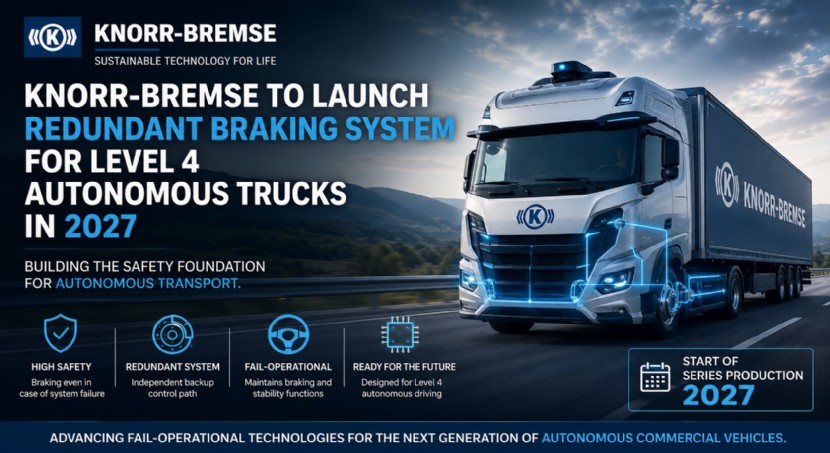
As the commercial vehicle industry moves closer to highly automated freight transport, Knorr-Bremse has announced a significant milestone for autonomous truck safety. The company confirmed that its Redundant Braking General System Brake Control (rGSBC) will enter series production in 2027, supporting the next generation of Level 4 autonomous commercial vehicles.
Unlike conventional braking architectures, the redundant braking system is designed to maintain essential braking and vehicle stability functions even if a primary brake control path fails. This fail-operational capability is considered one of the fundamental safety requirements for Level 4 autonomous driving, where vehicles must continue operating safely without immediate human intervention.
According to Knorr-Bremse, the rGSBC has been developed on the company's proven General System Brake Control (GSBC) platform, allowing the integration of redundant control architecture while leveraging an established braking technology platform.
Building the Safety Foundation for Autonomous Trucks
While public attention often focuses on sensors, artificial intelligence and autonomous driving software, highly automated commercial vehicles also require redundant safety systems capable of handling critical failures.
Knorr-Bremse's redundant braking technology ensures that anti-lock braking (ABS), electronic brake control and vehicle stability functions remain operational through an independent secondary control path in the event of a major system failure.
Part of a Fail-Operational Vehicle Architecture
The company also highlighted that redundant braking is only one element of a complete fail-operational vehicle architecture.
Alongside rGSBC, Knorr-Bremse is developing Electric Power Steering (EPS) and redundant Electric Power Steering (rEPS) systems, creating an integrated safety platform for highly automated commercial vehicles. Together, these technologies are designed to enable autonomous trucks to either continue operating safely or perform a controlled stop if a critical system fault occurs.
Industry Perspective
As manufacturers including Daimler Truck, Volvo Autonomous Solutions, Torc Robotics, Aurora, Plus and other autonomous driving developers accelerate Level 4 truck programmes, the supporting safety infrastructure is becoming increasingly important.
Knorr-Bremse's decision to industrialise its redundant braking technology marks another major step toward the commercial deployment of highly automated heavy-duty vehicles.
Kamyonum Analysis
The future of autonomous trucking will depend not only on artificial intelligence and perception systems but also on redundant safety architectures capable of maintaining vehicle control during unexpected failures.
Technologies such as redundant braking and steering systems are expected to become essential building blocks for the safe deployment of Level 4 commercial vehicles over the coming years.
YORUMLAR
Yorum Yap