










Why Is Europe's Electric Heavy-Duty Vehicle Transition Progressing More Slowly Than Expected?
While Europe's truck manufacturers have significantly expanded their battery-electric heavy-duty vehicle portfolios, the pace of market adoption remains below expectations. According to a joint call by ACEA and E-Mobility Europe, accelerating charging infrastructure, strengthening electricity grids and improving investment conditions are essential to achieving the European Union's zero-emission transport objectives.
- | Kamyonum
Why Is Europe's Electric Heavy-Duty Vehicle Transition Progressing More Slowly Than Expected?
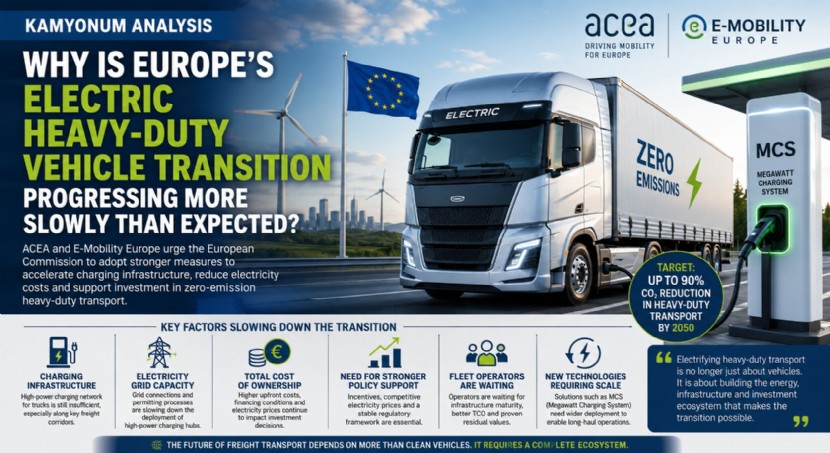
The European Union has set ambitious climate targets and is accelerating the transition towards zero-emission heavy-duty transport. However, industry stakeholders increasingly agree that the main barriers are no longer related to vehicle technology itself but rather to the broader ecosystem required to support large-scale deployment.
In a recent joint call to the European Commission, the European Automobile Manufacturers' Association (ACEA) and E-Mobility Europe urged policymakers to adopt ambitious measures within the upcoming Electrification Action Plan. Their recommendations focus on accelerating charging infrastructure deployment, reducing electricity costs, improving financing conditions and supporting private investment.
The Challenge Is No Longer Vehicle Technology
Europe's leading truck manufacturers—including Daimler Truck, Volvo Trucks, Scania, MAN Truck & Bus, Renault Trucks and IVECO—already offer battery-electric heavy-duty vehicles across multiple transport applications.
The industry therefore argues that the technological foundation is largely in place. The current challenge lies in ensuring that transport operators can use these vehicles efficiently across long-distance freight operations.
Charging Infrastructure Remains Critical
Heavy-duty electric vehicles require charging solutions that differ significantly from passenger cars.
Long-haul operations depend on high-power charging corridors, dedicated truck parking facilities and future Megawatt Charging System (MCS) technology capable of significantly reducing charging times.
Industry organisations continue to stress that infrastructure deployment must progress at the same pace as vehicle adoption.
Electricity Grid Capacity Is Becoming a Strategic Issue
Large logistics hubs and fleet depots require substantial grid connections to support high-power charging.
Without timely investment in electricity networks, even operators willing to electrify their fleets may experience delays in deploying charging infrastructure.
The European Commission's Electrification Action Plan therefore addresses not only vehicle deployment but also the wider energy ecosystem needed to support transport electrification.
Total Cost of Ownership Still Influences Investment Decisions
Fleet operators evaluate investments based on Total Cost of Ownership (TCO), considering vehicle purchase price, electricity costs, maintenance expenses, financing options, residual value and operational efficiency.
Although battery-electric trucks can reduce operating costs in certain applications, many transport companies remain cautious while waiting for infrastructure improvements and stronger policy support.
KAMYONUM ANALYSIS
Europe's transition toward zero-emission heavy-duty transport has entered a new phase.
The industry is no longer asking whether electric truck technology is ready. Instead, the discussion has shifted towards infrastructure readiness, electricity networks, charging availability and investment conditions.
The latest recommendations submitted by ACEA and E-Mobility Europe demonstrate that achieving Europe's climate objectives will depend on building an integrated transport and energy ecosystem rather than simply introducing new vehicle models.
IMPACT ON TURKISH TRANSPORT INDUSTRY
Türkiye plays a strategic role in European freight transport.
As electrification policies continue to evolve across the European Union, Turkish logistics operators, international hauliers and commercial vehicle manufacturers will increasingly be influenced by new infrastructure developments, regulatory frameworks and investment incentives.
The pace of Europe's transition is therefore expected to shape future fleet investment decisions throughout the region.
YORUMLAR
Yorum Yap