










EU Advocate General Challenges Austrian Truck Restrictions on Brenner Corridor
The EU Advocate General says several Austrian truck restrictions on the Brenner Corridor are incompatible with EU law. The final decision will be made by the Court of Justice of the European Union.
- | Kamyonum
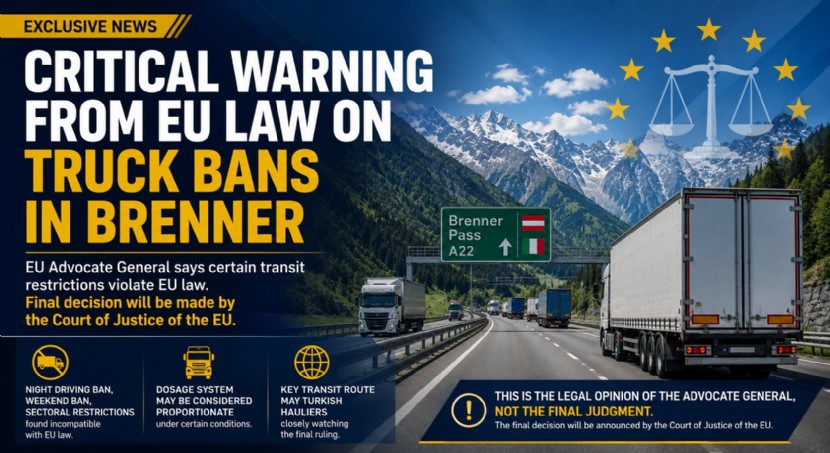
EU Advocate General Challenges Austrian Truck Restrictions on the Brenner Corridor
Certain Brenner Truck Bans Found Incompatible with EU Law
A major legal development has emerged regarding the Brenner Corridor, one of Europe's most important freight transport routes. The Advocate General of the Court of Justice of the European Union (CJEU) has concluded that several truck traffic restrictions imposed by Austria's Tyrol region are incompatible with European Union law.
The opinion concerns restrictions affecting one of the busiest road freight corridors connecting Germany and Italy, a key route used by international transport operators across Europe, including Turkish logistics companies serving Central and Western European markets.
However, it is important to note that the Advocate General's opinion is not the Court's final judgment. The Court of Justice of the European Union will issue its final ruling at a later date and is not legally bound to follow the Advocate General's opinion, although such opinions are frequently reflected in the Court's final decisions.
Which Restrictions Were Considered Incompatible?
According to the Advocate General, several measures introduced by Austria were found to be disproportionate or inconsistent with the EU principle of the free movement of goods, including:
- Night-time truck driving bans
- Winter Saturday truck bans
- Sectoral bans affecting specific categories of goods that could alternatively be transported by rail
The opinion states that these restrictions are either discriminatory or not sufficiently justified in achieving their environmental and air-quality objectives.
Dosage System May Still Be Justified
The legal opinion reached a different conclusion regarding the so-called truck dosage system, which limits the number of heavy goods vehicles entering the Tyrol section of the motorway.
Under the current system, traffic may be restricted to approximately 300 trucks per hour during periods of heavy congestion. The Advocate General indicated that this measure could be considered proportionate under certain circumstances, meaning not all Austrian traffic management measures were considered incompatible with EU law.
Why It Matters for Turkish Transport Operators
The Brenner Corridor is one of the most important transit routes connecting Türkiye with Germany, Italy, Austria, the Benelux countries and other Western European markets.
Any restrictions imposed along this corridor directly affect:
- International freight operations
- Transit times
- Fleet planning
- Logistics costs
- Supply chain efficiency
The CJEU's forthcoming final judgment could have significant implications for future transport regulations across Europe and will be closely monitored by the international road transport industry.
Kamyonum Analysis
Beyond the legal dispute itself, this case highlights the ongoing challenge of balancing environmental protection policies with the EU's fundamental principle of the free movement of goods.
Should the Court ultimately follow the Advocate General's opinion, Austria may be required to revise parts of its long-standing truck restriction regime in Tyrol. Such a decision could reshape freight transport operations along one of Europe's busiest logistics corridors and may directly influence Turkish carriers operating on international routes.
YORUMLAR
Yorum Yap