








New technologies introduced by heavy commercial vehicle and trailer manufacturers in 2026 signal significant changes in axle systems.
BPW's solution, capable of reducing weight by more than 100 kilograms on a three-axle trailer, SAF-HOLLAND's FUSION axle family offering a weight advantage of at least 120 kilograms, ZF's electric drive systems and DAF's new axle configurations are among the notable developments.
- | Kamyonum
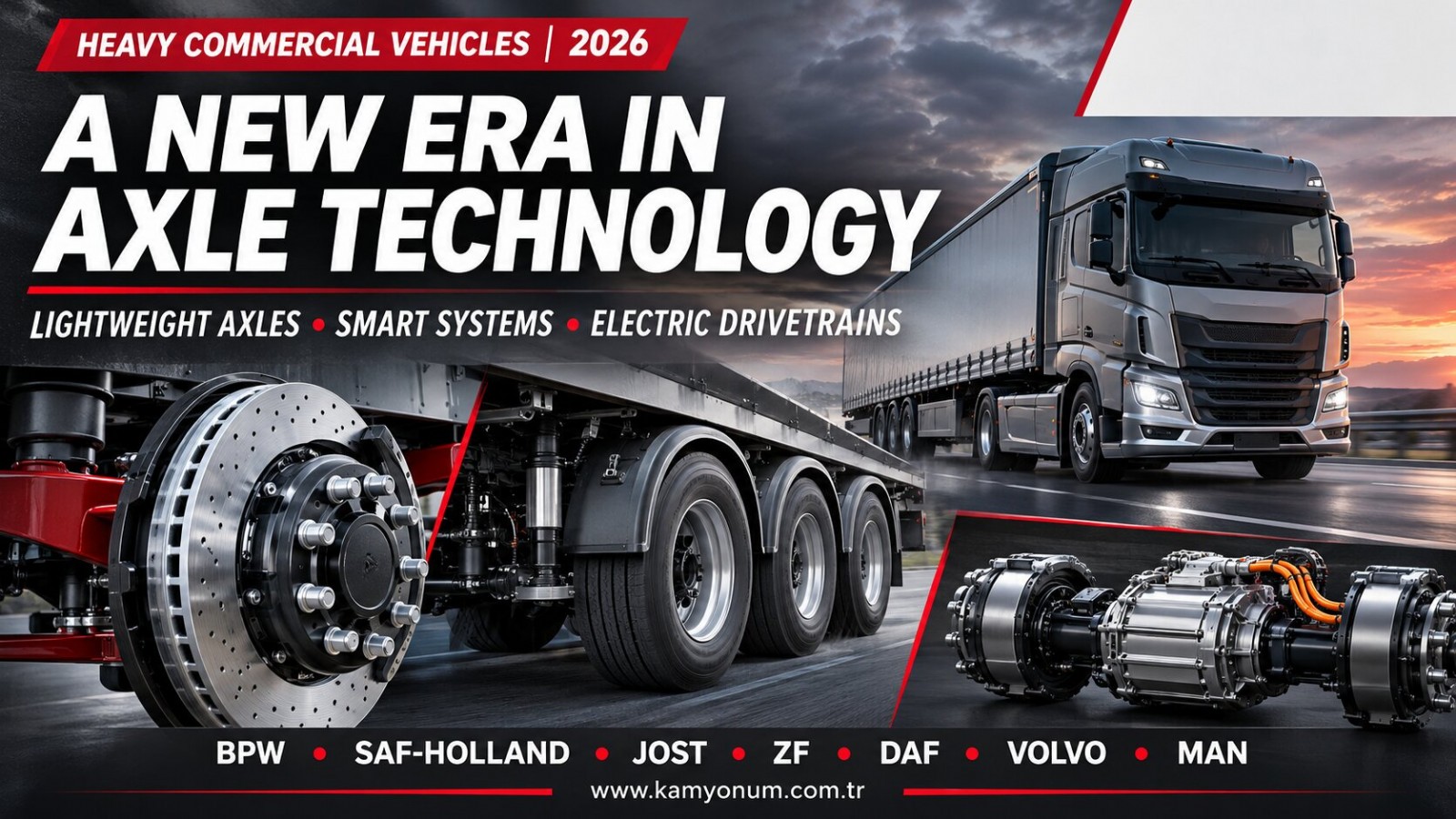
A New Era in Axle Technologies for Heavy Commercial Vehicles: Lightweight Axles, Smart Systems and Electric Drivetrains
Kamyonum examined manufacturers' technical announcements, series production schedules and the potential implications of these technologies for the Turkish transport industry.
Axle and running gear technologies in heavy commercial vehicles continue to evolve not only in terms of load capacity and mechanical durability, but also in vehicle weight, maintenance processes, digital monitoring and electric drive systems.
IAA Transportation, held in Hannover from 15 to 20 September 2026, showcased important examples of these innovations. While component manufacturers such as BPW, SAF-HOLLAND, JOST and ZF introduced new products, DAF, Volvo Trucks and MAN announced new axle and vehicle configurations for different transport applications.
However, not all these technologies are at the same stage of development. Some have already entered series production, while others are scheduled for market introduction in 2027, 2028 or later.
BPW: More Than 100 Kilograms of Weight Reduction on a Three-Axle Trailer with a New Wheel-End System
On 14 September 2026, BPW introduced its Wheelend ECO Pro wheel-end system for 9-tonne trailer axles.
Developed for axle applications using disc brakes with a 120 mm offset, the new system delivers a weight reduction of 20 kilograms per axle compared with the manufacturer's previous reference solution. This corresponds to a total reduction of 60 kilograms on a three-axle trailer.
When Wheelend ECO Pro is combined with the Airlight II air suspension and LightTube trailing arm, the total weight advantage reaches 34 kilograms per axle. This allows a three-axle trailer to achieve a weight reduction exceeding 100 kilograms.
These figures refer to different configurations. Therefore, the 60-kilogram and more-than-100-kilogram weight advantages should not be added together.
The new system features a bionically designed wheel hub and brake disc, a redesigned bearing arrangement and a central axle nut intended to simplify maintenance operations.
BPW also states that reduced friction losses may contribute to lower fuel consumption. However, the published information does not include an independently verified percentage of fuel savings.
The manufacturer has announced an eight-year warranty without a mileage limit for Wheelend ECO Pro, subject to registration requirements.
Small-scale production is scheduled to begin in 2027, followed by series production in 2030.
SAF-HOLLAND: At Least 120 Kilograms of Weight Savings with the FUSION Axle Family
SAF-HOLLAND introduced its new SAF FUSION axle family at IAA Transportation 2026.
SAF FUSION complements the company's SAF INTRA and SAF MODUL product families and is designed for applications requiring axle load capacities of up to 11 tonnes.
According to SAF-HOLLAND, the new axle family provides a weight reduction of more than 40 kilograms per axle compared with the SAF solution previously used in equivalent applications. On a three-axle unit, the total weight reduction reaches at least 120 kilograms.
The system is based on the further development of an axle concept previously marketed by Assali Stefen, combined with SAF components.
The new axle family incorporates a patented, maintenance-free connection solution. According to the manufacturer, this feature specifically concerns the connection between the axle and axle tube. It does not mean that all axle and brake components are maintenance-free.
Series production of the first SAF FUSION applications is scheduled to begin in the second quarter of 2028.
The announced weight advantage is based on the manufacturer's technical comparison and should not be interpreted as an operational cost-saving result independently verified through field tests in Türkiye.
BPW: Road Condition Monitoring Tracks Actual Trailer Operating Conditions
On 28 October 2026, BPW announced a new software function called Road Condition Monitoring (RCM).
RCM has been developed as an additional feature of BPW's iC Plus intelligent trailer running gear platform.
Rather than assessing only the distance travelled, the system also evaluates the load and road conditions experienced by the trailer during operation.
RCM uses pressure data from the existing air suspension system. By analysing pressure fluctuations caused by road surface irregularities, the system assesses the stresses experienced by the running gear.
Distance travelled is classified into different stress categories. The system also considers whether the vehicle is lightly, moderately or heavily loaded.
These data allow a more detailed analysis of the trailer's operating history.
BPW states that the new function requires no additional sensors or wiring beyond the existing iC Plus infrastructure. Results can be displayed through idem telematics' Cargofleet 3 platform.
The system is intended to support maintenance planning, vehicle utilisation assessments and the evaluation of operating conditions experienced by second-hand vehicles.
However, RCM should not be described as a device that directly measures road surface quality or as a system capable of predicting every mechanical failure.
JOST: DCA One4All Brings Disc and Drum Brake Axles onto a Common Platform
JOST announced its new DCA One4All axle platform at IAA Transportation 2026.
The main feature of DCA One4All is the integration of disc-brake and drum-brake axle variants within a common technical architecture.
This approach aims to provide a shared product platform for trailer applications with different braking requirements.
The modular design is expected to simplify the management of product configurations for trailer manufacturers.
However, the manufacturer's reviewed announcement does not specify any quantitatively verified weight reduction, fuel consumption improvement or maintenance cost advantage for DCA One4All.
These characteristics should therefore be considered part of the platform's technical design approach rather than measured economic results.
ZF: Higher Torque and New Applications for Electric Drive Axles
At IAA Transportation 2026, ZF presented developments in its electric drive systems for commercial vehicles.
The company announced that increased output torque in its AxTrax 2 electric drive axle expands potential applications for vehicles operating at higher gross combination weights.
According to ZF, production of AxTrax 2 has started in China, while a significant city bus order has been secured in India for the AxTrax 2 LF electric portal axle.
The company also announced the start of series production in Europe for its CeTrax 2 dual electric drive system.
AxTrax 2, AxTrax 2 LF and CeTrax 2 dual are distinct products. Their technical specifications and applications should not be confused.
ZF is also developing digital condition-monitoring solutions for electric drive systems.
In particular, the Health Check software offered for AxTrax 2 LF is designed to enable remote assessment of electric drivetrain components and support early identification of potential problems.
These technologies demonstrate how maintenance systems and power transmission technologies are evolving together in electric commercial vehicles.
However, power, torque and efficiency figures from different products should not be presented as though they belong to a single vehicle application.
DAF: Technical Gross Vehicle Weight of Up to 54 Tonnes for Five-Axle 10x4 Trucks
DAF Trucks introduced a new five-axle 10x4 truck configuration for its XD and XF models at IAA Transportation 2026.
Developed particularly for construction and heavy-duty applications, the vehicle features two steerable front axles, with 8-, 9- and 10-tonne front axle options.
At the rear, a 34-tonne tridem arrangement combines a tandem group of two driven axles with an additional liftable and steerable axle.
DAF specifies a technical maximum gross vehicle weight of up to 54 tonnes for this configuration.
The company also introduced new axle configurations for its electric trucks.
These include 6x2 tractor units with a steerable auxiliary axle, 6x2 rigid trucks with a 10-tonne twin-wheel rear auxiliary axle, and 6x4 and 8x4 models equipped with driven tandem axle groups rated at 19 or 21 tonnes.
DAF's revised battery positioning in its electric vehicles is also significant in terms of load distribution.
By removing the battery pack from beneath the cab and positioning the batteries further rearward, the front axle load can be reduced by approximately 700 kilograms.
DAF states that this change can provide a payload capacity advantage of up to 2.5 tonnes in certain configurations.
This does not mean that the vehicle's total unladen weight has been reduced by 2.5 tonnes. The advantage is related to improved load distribution and the technical limits of the relevant vehicle configuration.
Furthermore, the announced 54-tonne technical capacity should not be interpreted as the legal weight limit applicable in Türkiye.
Volvo Trucks: E-Axle and Hub Reduction Axle Technologies for Electric Trucks
Volvo Trucks announced new drive and axle solutions for its electric heavy commercial vehicles in 2026.
The e-axle technology used in the company's long-range FH Aero Electric allows additional space for battery capacity through the arrangement of electric drivetrain components.
Volvo states that this long-range vehicle configuration can achieve a driving range of up to 700 kilometres under suitable conditions.
On 14 September 2026, the company also introduced a separate electric heavy-haulage solution designed for gross combination weights of up to 80 tonnes.
This application was developed particularly for truck and trailer combinations operating at high gross weights.
The vehicle uses hub reduction axles, designed to improve starting capability under heavy loads and provide greater ground clearance beneath the axles.
According to Volvo's published figures, the vehicle can achieve a range of up to 450 kilometres at a gross combination weight of 64 tonnes and up to 420 kilometres at a gross weight of 74–76 tonnes.
The system has 640 kWh of usable battery energy.
The manufacturer states that, with 680 kW MCS charging power, the battery can be charged from 20% to 80% in approximately 36 minutes.
The new heavy-haulage solution is scheduled for phased market introduction in selected European markets from early 2027.
The long-range FH Aero Electric, with its announced range of up to 700 kilometres, and the 80-tonne heavy-haulage application are different configurations. Their technical specifications should not be presented as those of a single vehicle model.
MAN: Up to 720 Kilometres of Range for the Three-Axle eTGX Tractor Unit
MAN has announced a battery capacity of up to 644 kWh and a driving range of up to 720 kilometres for its new eTGX 6x2-4 electric tractor configuration equipped with seven battery packs.
This range figure is based on specific operating conditions defined by the manufacturer.
According to MAN, these conditions include an ambient temperature of 20°C, a 60% load level, Class A tyres, exclusively motorway driving, a new battery, no use of the power take-off and operation within a specified battery discharge range.
Therefore, the 720-kilometre figure should not be regarded as a fixed range achievable under all loads, routes and weather conditions.
The three-axle eTGX tractor is being developed particularly for applications requiring high fifth-wheel loads and long-distance transport operations.
MAN plans to begin sales of the new configuration in early April 2027, with production scheduled to start in summer 2027.
The vehicle should therefore be regarded as a solution introduced in 2026 whose new configuration has not yet entered series production.
What Will These Technologies Mean for Transport Operators in Türkiye?
The potential economic contribution of next-generation axle technologies to the Turkish transport industry will vary depending on the application and vehicle configuration.
Weight-saving solutions may help increase net payload, particularly in tanker, bulk cargo and heavy-duty transport operations where vehicles frequently reach legal weight limits.
However, every kilogram saved on a trailer does not necessarily translate into an equivalent increase in payload across all transport operations. Axle load limits, load distribution and the characteristics of the goods being transported all affect the potential advantage.
New designs that simplify maintenance may also help improve the efficiency of service operations.
To determine their actual economic value, factors such as labour costs, spare parts, maintenance intervals and vehicle downtime must be assessed.
Digital monitoring systems allow operators to evaluate vehicle operating conditions in greater detail.
Nevertheless, independent field results are required before such data can be translated into specific percentage reductions in maintenance costs.
Electric drive axles and new axle configurations also create different opportunities in commercial vehicle design.
However, energy consumption and driving range do not depend solely on axle technology. They are determined by a combination of battery capacity, vehicle weight, aerodynamics, route characteristics and operating conditions.
For operators in Türkiye, purchase prices, market availability, service and spare parts support, regulatory compliance and total cost of ownership will be decisive factors.
Manufacturers Are Pursuing Different Priorities in Axle Technologies in 2026
A comparison of the developments announced by manufacturers shows that no single axle technology can meet every transport requirement.
BPW's Wheelend ECO Pro focuses on reducing the weight of wheel-end components and simplifying maintenance, while SAF-HOLLAND's FUSION family aims to provide weight advantages in applications requiring higher axle load capacities.
JOST's DCA One4All platform brings disc and drum brake options together within a common axle architecture, offering trailer manufacturers greater flexibility in product configurations.
BPW's Road Condition Monitoring solution goes beyond mechanical design by focusing on the digital assessment of actual running gear operating conditions.
ZF is contributing to the transformation of power transmission systems through electric drive axles, while DAF, Volvo Trucks and MAN are integrating new axle configurations with vehicle payload requirements, battery positioning and operational needs.
Because these technologies have been developed for different purposes, it is difficult to establish a direct ranking of manufacturers based solely on announced weight or load capacity figures.
Series Production Timelines Will Be Crucial for New Technologies
Not all axle technologies introduced in 2026 will become commercially available at the same time.
BPW is targeting small-scale production of Wheelend ECO Pro in 2027 and series production in 2030, while SAF-HOLLAND expects series production of the first FUSION applications to begin in the second quarter of 2028.
Production has already started for certain ZF electric drive solutions.
For MAN's new three-axle electric tractor configuration, sales and production are scheduled to begin in 2027.
These differences demonstrate that the influence of new technologies on purchasing decisions will depend not only on their technical characteristics but also on their market introduction schedules.
For Turkish transport operators and trailer manufacturers, the timing of local availability, compatibility with existing vehicles and after-sales support conditions will be particularly important.
Conclusion: Real-World Operating Conditions Will Determine the Winners in the New Axle Technology Race
Axle technologies for heavy commercial vehicles continue to evolve in 2026, with manufacturers focusing on weight reduction, digitalisation, electric drivetrains and adaptability to different load requirements.
BPW's lightweight wheel-end solution, SAF-HOLLAND's new axle family, JOST's modular platform and ZF's electric drive systems illustrate different aspects of this transformation.
Meanwhile, new vehicle configurations developed by DAF, Volvo Trucks and MAN demonstrate that axle systems are no longer viewed merely as mechanical components, but as critical engineering elements influencing overall vehicle design.
However, a clear distinction must be made between the technical advantages announced by manufacturers and the economic benefits transport operators can achieve under actual operating conditions.
Whether weight reductions translate into additional payload, digital monitoring reduces maintenance costs, or electric drive systems improve operating expenses will depend on vehicle configurations, usage conditions and long-term field data.
Ultimately, the winners in the next phase of axle technology competition will not be determined solely by lighter, more powerful or more advanced systems, but by the reliability, efficiency and measurable economic benefits these technologies deliver to transport operators in real-world operations.
YORUMLAR
Yorum Yap