












Australia Changes Heavy Vehicle Rules: 20-Metre Length and Higher Mass Limits Take Effect
Australia’s updated HVNL rules took effect on 1 August 2026. Certain heavy vehicle combinations can now operate up to 20 metres, while higher mass limits and new safety requirements have also been introduced.
- | Kamyonum
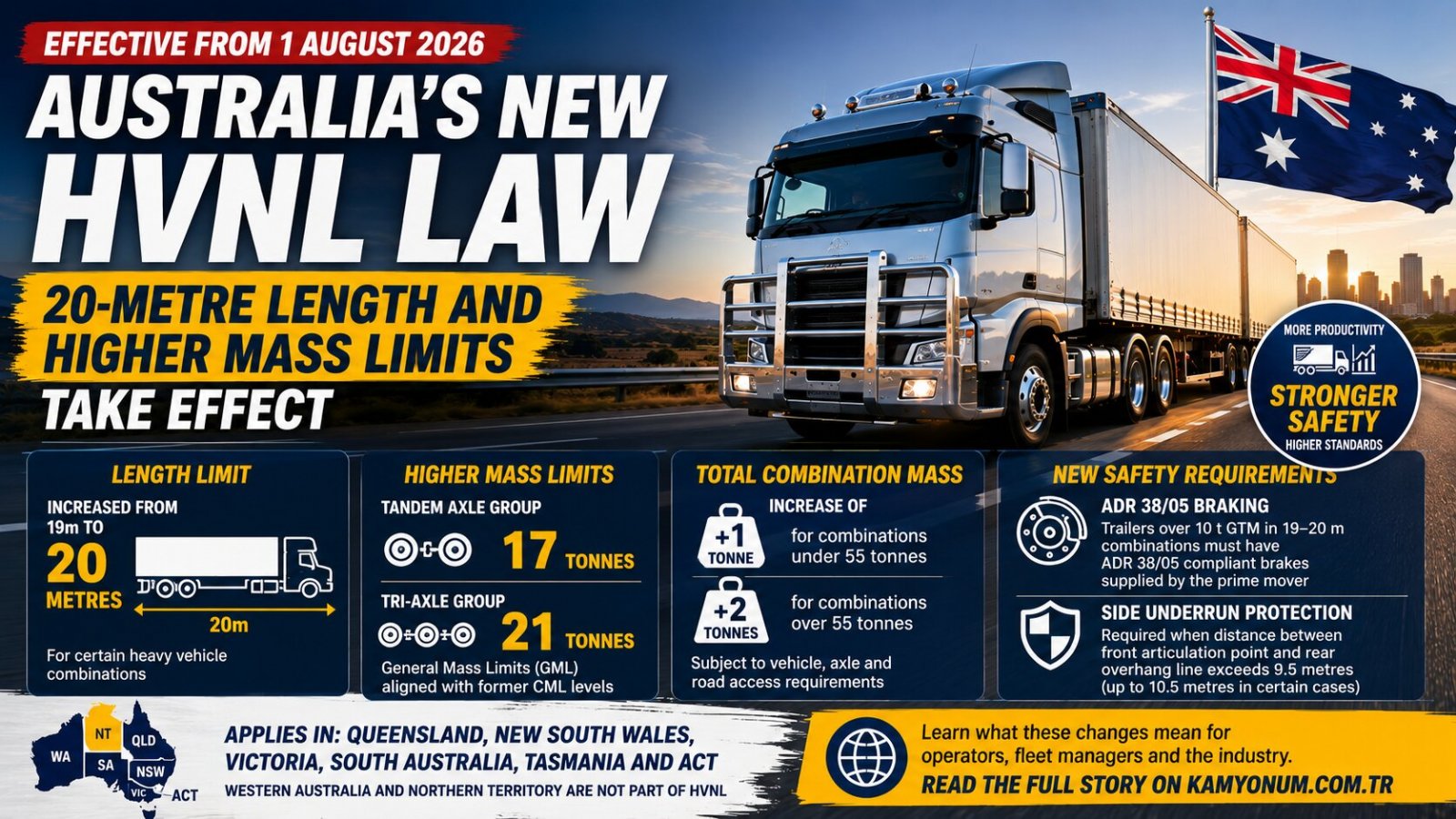
Australia has entered a significant new regulatory era for heavy vehicle transport.
Changes to the Heavy Vehicle National Law (HVNL) and associated regulations took effect on 1 August 2026, introducing important reforms covering vehicle dimensions, mass limits, safety requirements and regulatory compliance.
The changes are intended to create a more flexible, risk-based and outcomes-focused regulatory framework while improving both the productivity and safety of heavy vehicle operations.
However, the reform should not be interpreted as meaning that “all heavy vehicles across Australia can now operate at 20 metres.”
The HVNL applies in Queensland, New South Wales, the Australian Capital Territory, Victoria, Tasmania and South Australia. Western Australia and the Northern Territory operate under separate heavy vehicle regulatory frameworks.
Length Limit Increases from 19 to 20 Metres for Certain Combinations
One of the most significant changes for fleet operators and trailer manufacturers is the increase in the general access length limit for certain heavy vehicle combinations.
Under the new rules, the maximum general access length for specified combinations has increased from 19 metres to 20 metres.
The affected combinations include:
- prime mover and semitrailer combinations;
- rigid truck and pig trailer combinations;
- rigid truck and dog trailer combinations; and
- rigid truck and tag trailer combinations.
The change therefore creates additional flexibility for specific heavy vehicle configurations rather than introducing a universal 20-metre limit across the entire heavy vehicle fleet.
B-doubles Are Not Included in This Particular Change
An important distinction needs to be made regarding B-doubles.
The new 19-to-20-metre general access change does not apply to B-double combinations.
The reform should therefore not be interpreted as a general one-metre increase for every heavy vehicle combination operating under the HVNL.
Longer Combinations Come with Additional Safety Requirements
The additional length is accompanied by technical safety requirements.
For certain combinations operating at more than 19 metres and up to 20 metres, trailer braking specifications become particularly important.
ADR 38/05-Compliant Braking Systems
For combinations exceeding 19 metres but not exceeding 20 metres, trailers with a Gross Trailer Mass (GTM) of more than 10 tonnes must meet the applicable ADR 38/05 or later ADR 38 braking requirements.
The braking system must also be supplied from the towing vehicle.
This distinction is important.
It would therefore be inaccurate to simply state that “every trailer operating between 19 and 20 metres must have ADR 38/05 brakes.”
The requirement depends on the relevant combination and trailer specifications.
9.5 Metres Becomes a Critical Threshold for Side Underrun Protection
Another significant technical issue concerns Side Underrun Protection (SUP).
For a semitrailer, where the distance between the front articulation point and rear overhang line exceeds 9.5 metres, side underrun protection meeting the applicable ADR 106/00 or later requirements becomes relevant.
The revised dimensional framework can allow this distance to extend to up to 10.5 metres under specified conditions, depending on the vehicle configuration.
For trailer manufacturers, this means that longer semitrailer designs must be considered together with axle positioning, rear overhang geometry and side protection requirements.
General Mass Limits Increase
The HVNL reforms are not limited to vehicle dimensions.
The changes to General Mass Limits (GML) are potentially just as important for transport operators.
Under the new framework, GML levels are being aligned with mass levels that were previously available under Concessional Mass Limits (CML).
This means eligible operators can gain access to higher general mass levels without requiring the previous Mass Management accreditation solely for accessing CML mass levels.
Separate requirements continue to apply to other schemes, including Higher Mass Limits (HML), Performance Based Standards (PBS) and certain special access arrangements.
Tandem Axle Limit Rises to 17 Tonnes
The revised mass limits include important changes to axle groups.
For applicable dual-tyred tandem axle groups, the limit increases to:
17 tonnes
while eligible dual-tyred tri-axle groups can reach:
21 tonnes.
The previous general limits for these axle groups were 16.5 tonnes and 20 tonnes respectively.
For suitable vehicle configurations, these changes can translate into increased legal payload capacity.
Up to One or Two Tonnes of Additional Combination Mass
The reforms can also increase the total permitted mass of eligible combinations.
Depending on the vehicle configuration, the increase can reach:
up to 1 tonne for combinations below 55 tonnes
and
up to 2 tonnes for combinations above 55 tonnes.
However, this does not mean that every vehicle can automatically carry one or two additional tonnes.
Manufacturer-rated limits, including GVM and GCM, axle and suspension capacities, vehicle configuration and road-access requirements remain critical constraints.
Previous CML Accreditation No Longer Required Solely for the New GML Levels
The administrative implications are also significant.
Under the previous framework, operators seeking access to CML mass levels could be required to participate in the Mass Management accreditation scheme.
By incorporating these higher mass levels into the revised GML framework, the former CML accreditation requirement is no longer necessary solely to access those new general mass levels.
However, accreditation and other conditions can continue to apply to Higher Mass Limits, PBS operations and other specific access arrangements.
What Does the Reform Mean for Transport Operators?
For eligible fleets, the reform creates two potentially important operational advantages:
longer vehicle combinations
and
higher legal mass limits.
The additional metre does not necessarily mean more payload by weight on every journey.
For volume-limited freight, however, additional vehicle length may create opportunities for greater cubic capacity.
Higher mass limits, meanwhile, can provide benefits for weight-limited freight operations.
Where both factors can be used effectively, operators may potentially reduce the number of trips or vehicle kilometres required to move a given amount of freight.
This remains an operational possibility rather than an automatic result. The actual productivity benefit will depend on freight type, vehicle configuration, route and access conditions.
New Design Considerations for Trailer Manufacturers
The changes are also particularly relevant to trailer manufacturers and component suppliers.
When designing longer semitrailers, manufacturers must consider more than total vehicle length.
Key parameters include:
axle geometry,
rear overhang,
braking systems,
side underrun protection,
and
prime mover–trailer compatibility.
The interaction between the additional dimensional flexibility and ADR 38/05 and ADR 106/00 requirements means the reform could also influence demand for safety components and compliant trailer technologies.
A 20-Metre Vehicle Does Not Automatically Have Access to Every Road
There is another important operational distinction.
Being technically eligible to operate as a 20-metre combination does not automatically mean that the vehicle can use every road within an HVNL jurisdiction at that length.
Operators must continue to comply with applicable network-access conditions and any restrictions imposed by the relevant road manager.
Route planning therefore remains a critical part of heavy vehicle operations even where the vehicle itself complies with the revised dimensional limits.
The HVNL Reform Goes Beyond Length and Mass
The 1 August 2026 reforms cover a much broader regulatory package than vehicle dimensions and payload.
Changes also address areas including:
Heavy Vehicle Accreditation,
Safety Management Systems,
enforcement and compliance,
driver fitness,
work diary requirements,
mass, dimension and loading rules,
and other aspects of heavy vehicle regulation.
The 20-metre length and revised mass limits are therefore only some of the most commercially visible elements of the broader HVNL reform.
Kamyonum Analysis: Greater Productivity Comes with Greater Technical Responsibility
The underlying direction of Australia's heavy vehicle reform is particularly noteworthy.
Operators are being given access to greater productivity potential, while technical compliance and safety requirements remain central to that additional flexibility.
The increase from 19 to 20 metres can provide additional capacity for eligible combinations.
Higher GML levels can also increase the legal payload potential of suitable vehicles.
However, taking advantage of these changes requires compliance with factors including:
braking requirements,
side underrun protection,
axle and vehicle ratings,
road access conditions,
and
manufacturer technical limits.
The reform therefore should not simply be described as allowing “longer and heavier trucks.”
Its broader message is:
Higher productivity in return for stronger technical compliance.
For Europe and Türkiye, where heavy vehicle dimensions, weights, transport efficiency and emissions continue to be discussed, Australia's approach also provides an interesting regulatory case study to follow.
Australia HVNL 2026: Frequently Asked Questions
When did the updated HVNL rules take effect?
The amended Heavy Vehicle National Law and associated regulations took effect on 1 August 2026 in participating HVNL jurisdictions.
Has the maximum heavy vehicle length increased to 20 metres?
For certain specified heavy vehicle combinations, the general access length limit has increased from 19 metres to 20 metres. The change does not apply universally to all heavy vehicles.
Are B-doubles included in the 20-metre change?
No. B-doubles are not included in this specific 19-to-20-metre general access change.
What braking requirements apply to trailers in 19–20 metre combinations?
For applicable combinations exceeding 19 metres but not exceeding 20 metres, trailers with a Gross Trailer Mass of more than 10 tonnes must meet the applicable ADR 38/05 or later braking requirements, including the relevant towing-vehicle supply requirement.
When is side underrun protection required?
For relevant semitrailers, where the distance between the front articulation point and rear overhang line exceeds 9.5 metres, the applicable ADR 106/00 or later Side Underrun Protection requirements must be considered.
What is the new tandem axle mass limit?
For applicable dual-tyred tandem axle groups, the revised limit is 17 tonnes.
What is the new tri-axle mass limit?
Eligible dual-tyred tri-axle groups can operate at up to 21 tonnes, subject to the applicable requirements.
Does the new HVNL apply throughout Australia?
No. The HVNL applies in Queensland, New South Wales, the Australian Capital Territory, Victoria, Tasmania and South Australia. Western Australia and the Northern Territory operate under separate heavy vehicle regulatory systems.
Sources
The primary sources for this report are the National Heavy Vehicle Regulator (NHVR) and the National Transport Commission (NTC), including their 2026 HVNL reform, mass, dimension, loading and accreditation guidance.
YORUMLAR
Yorum Yap