










KARSAN ADVANCES TOWARD NET-ZERO MANUFACTURING
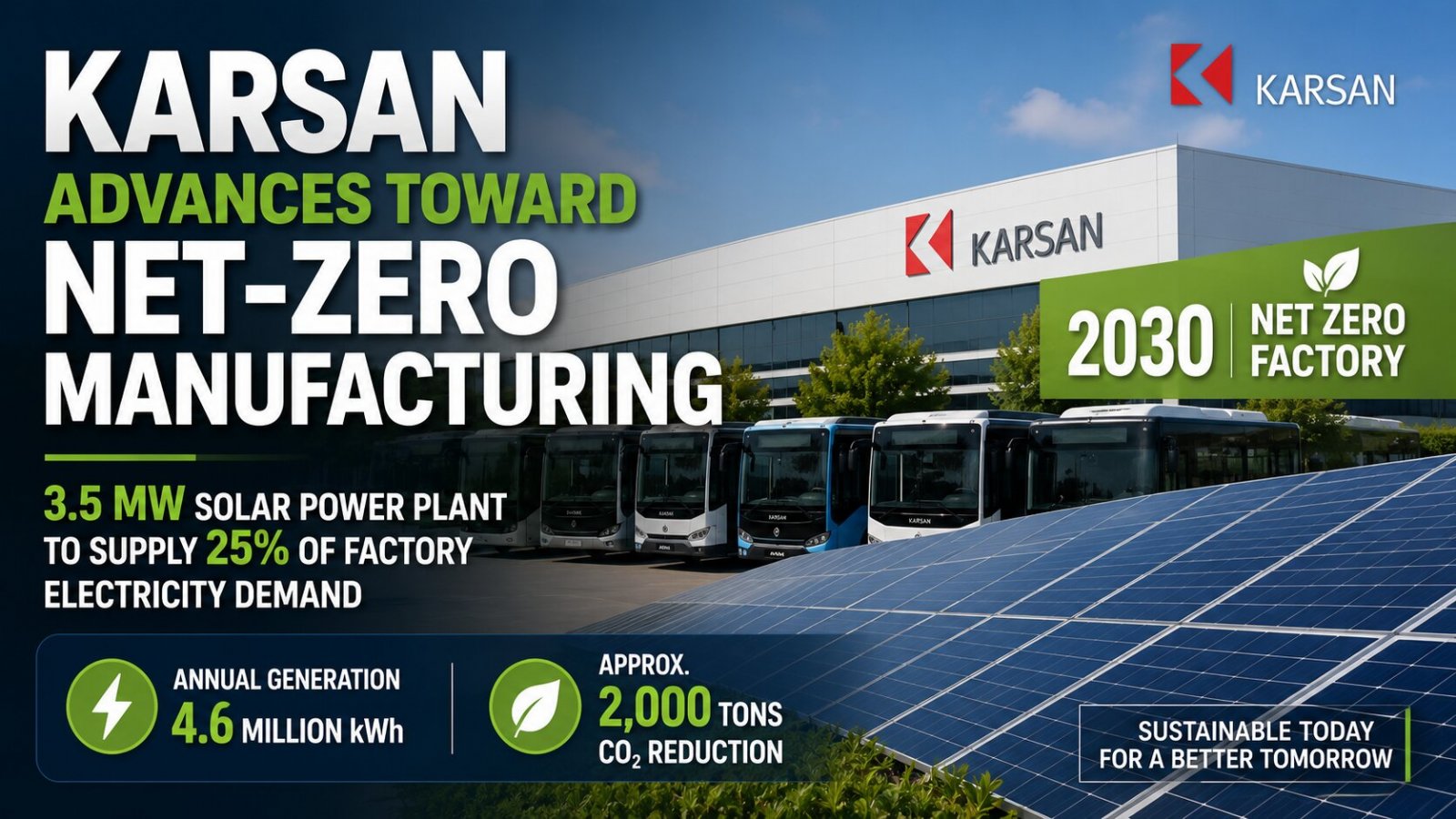
Karsan has commissioned a 3.5 MW solar power plant at its Bursa manufacturing facility, generating enough renewable electricity to cover approximately 25% of the plant's annual energy demand while supporting its 2030 Net Zero Factory target.
- | Kamyonum
Karsan Advances Toward Net-Zero Manufacturing with 3.5 MW Solar Power Plant
BURSA, Türkiye — Turkish public transport manufacturer Karsan has commissioned a 3.5 MW DC Solar Power Plant (SPP) at its manufacturing facility in Bursa, taking another significant step toward its 2030 Net Zero Factory target.
The renewable energy investment is expected to generate approximately 4.6 million kWh of electricity annually, covering around 25% of the plant's total electricity consumption. According to the company, the generated renewable energy will be sufficient to supply the electricity required to manufacture approximately 1,000 electric vehicles each year.
As demand for low-carbon manufacturing continues to grow across the global automotive industry, Karsan aims to reduce not only emissions from vehicle operation but also those generated during production.
Renewable energy becomes part of vehicle manufacturing
Commenting on the project, Utku Can Ayyarkın, CEO of Karsan, said the company views sustainable mobility as a concept that begins on the production line.
"We believe sustainable mobility starts long before vehicles reach the road. Our objective is to reduce not only operational emissions but also the carbon footprint generated throughout our manufacturing processes."
Ayyarkın added that renewable energy investments form a key pillar of Karsan's long-term competitiveness, energy security strategy and environmental commitments.
Around 2,000 tonnes of CO? emissions avoided annually
Completed in approximately six months, the project includes engineering, procurement, installation, testing and commissioning activities while allowing production operations to continue without interruption.
The solar installation utilizes locally manufactured 620 Wp TopCon bifacial photovoltaic panels together with high-efficiency inverters. The bifacial technology enables electricity generation from both direct sunlight and reflected light, improving overall system efficiency.
Karsan estimates the project will prevent approximately 2,000 tonnes of CO? emissions annually, strengthening the company's low-carbon manufacturing strategy.
Preparing for Europe's carbon regulations
Beyond reducing energy costs, the investment also supports Karsan's preparations for future environmental regulations, including the European Green Deal and the Carbon Border Adjustment Mechanism (CBAM).
By increasing the share of renewable electricity in production, the company aims to reduce future carbon-related costs while improving energy resilience and production sustainability.
Kamyonum Analysis
As the commercial vehicle industry accelerates its transition toward electrification, manufacturers are increasingly focusing on the carbon footprint of their production facilities alongside vehicle emissions. Investments such as Karsan's new solar power plant illustrate how renewable energy is becoming an integral part of industrial competitiveness, particularly for companies supplying the European market under increasingly stringent carbon regulations.
YORUMLAR
Yorum Yap