










Europe Enters a New Era in Public Transport: From Fixed Routes to Demand-Responsive Smart Mobility Systems
Public transport across Europe is undergoing one of its most significant transformations in recent years. While electric buses, zero-emission targets and digital ticketing continue to dominate the agenda, transport authorities are increasingly asking a different question:
- | Kamyonum
"Does it still make sense to operate empty buses on fixed routes every day?"
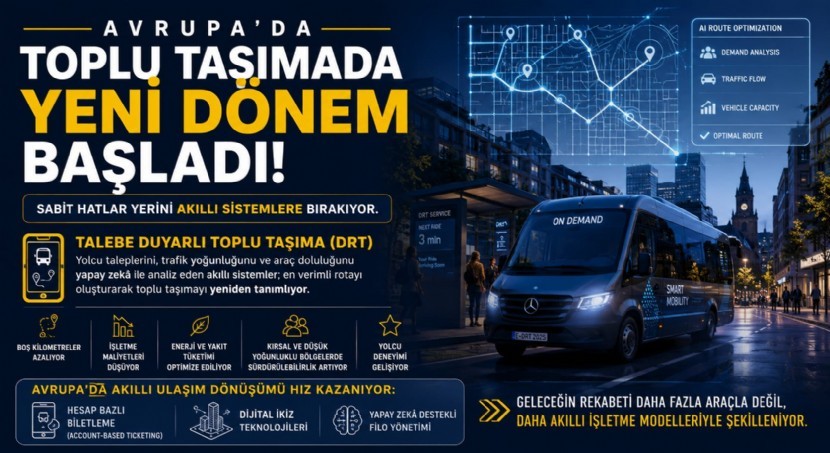
Rising operating costs, persistent driver shortages, changing passenger travel patterns and the need to use public resources more efficiently are prompting cities across Europe to rethink the traditional fixed-route model. As a result, Demand Responsive Transport (DRT) is rapidly gaining momentum as a flexible and data-driven mobility solution.
According to the International Association of Public Transport (UITP), DRT enhances accessibility and reduces waiting times, particularly in areas with low passenger demand. In its global assessment, UITP notes that DRT is no longer limited to rural communities but is increasingly being deployed in city centres, for late-night services, first- and last-mile connections, and airport access.
From Fixed Routes to Intelligent Routing
Traditional public transport operates on predetermined routes and timetables, regardless of whether vehicles are full or nearly empty.
Demand Responsive Transport follows a fundamentally different approach.
Passengers submit their travel requests via a mobile application, website or call centre. Artificial intelligence-powered software then matches passengers travelling in similar directions and calculates the most efficient route within seconds.
As a result, buses or minibuses only serve locations where actual demand exists.
This approach delivers several operational benefits:
-
Reduced empty vehicle mileage
-
Lower fuel and energy consumption
-
Improved operating cost efficiency
-
Shorter passenger waiting times
-
More sustainable public transport services in rural and low-density areas
According to Interreg Europe, DRT provides a flexible and cost-effective alternative positioned between conventional fixed-route public transport and traditional taxi services.
Expanding Applications Across Europe
Initially introduced to improve mobility in rural areas and communities with ageing populations, DRT systems are now being adopted in a much wider range of transport services.
Emerging applications include:
-
Airport connections
-
Industrial zones
-
University campuses
-
Late-night public transport
-
Suburban services
-
First- and last-mile mobility
In many cities, DRT operates as a feeder service connecting passengers to metro, tram and rail stations, while in others it has begun replacing underutilised fixed bus routes.
UITP's international case studies demonstrate that there is no single DRT model. Instead, transport authorities are designing systems tailored to local demographics, passenger demand and existing transport networks.
Artificial Intelligence at the Core of Operations
The latest generation of DRT systems goes far beyond digital booking platforms.
AI-powered software simultaneously analyses:
-
Real-time passenger requests
-
Traffic conditions
-
Vehicle occupancy
-
Journey times
-
Transfer connections
Using these data, the system continuously determines the most efficient route and vehicle allocation.
According to the OECD's 2026 assessment of artificial intelligence applications in the European Union, demand-responsive transport, route optimisation and passenger flow management are among the leading AI applications in public transportation.
Digital Twin Technology is Transforming Transport Planning
Another major innovation emerging across Europe is the use of Digital Twin technology.
Under this approach, an entire city's transport network is replicated in a virtual environment.
Before launching a new route, transport planners can simulate:
-
Passenger demand
-
Traffic conditions
-
Intersection congestion
-
Vehicle capacity
-
Waiting times
These scenarios can be evaluated before any physical investment is made.
For example, digital twin initiatives developed in Munich are enabling transport authorities to integrate real-time operational data into network planning, supporting more informed and lower-risk investment decisions.
Ticketing Systems Are Also Evolving
The transformation extends beyond vehicles and operations.
Many European cities are adopting Account-Based Ticketing (ABT) systems.
Under this model, passengers no longer need to carry a physical travel card.
Instead, all journeys made using a contactless bank card, smartphone or smartwatch are linked to the passenger's account. At the end of the day, the system automatically calculates and applies the most economical fare.
This approach not only improves the passenger experience but also provides transport operators with richer demand data to support future service planning.
Autonomous Buses: Progress Continues, Large-Scale Deployment Remains Limited
Autonomous shuttle buses and driverless minibus projects continue to expand across Europe and Asia.
However, contrary to widespread public perception, autonomous vehicles have not yet become a mainstream component of urban public transport.
Most pilot projects currently operate within controlled environments such as:
-
University campuses
-
Technology parks
-
Airports
-
Private sites and business parks
As vehicle type approval procedures, safety standards and regulatory frameworks continue to evolve across Europe, large-scale deployment in urban transport networks is expected to require additional time.
What Could This Mean for Türkiye?
In Türkiye's major metropolitan areas, conventional bus services and rail investments will remain essential along high-demand corridors.
However, Demand Responsive Transport could provide significant opportunities for:
-
Rural communities
-
Low-density suburban districts
-
Late-night transport services
-
Organised industrial zones
-
Airport connections
-
Newly developed residential areas
At a time when operating costs are rising, driver recruitment remains challenging and transport efficiency is becoming increasingly important, DRT offers municipalities a practical way to optimise resources while maintaining service quality.
Conclusion
The future of public transport is no longer defined simply by purchasing more buses, but by operating existing fleets more intelligently.
When combined with electrification, digital ticketing, artificial intelligence and demand-responsive operations, Europe's public transport systems are moving towards a more flexible, data-driven and passenger-focused model.
As this transformation continues, Europe's experience is expected to provide valuable guidance for municipalities and urban mobility planners across Türkiye in the years ahead.
YORUMLAR
Yorum Yap